Blockchain Development Company
Blockchain Autos builds the machine economy. Devices hold wallets, carry on-chain identity and pay for charging, tolls, parking and compute autonomously. No intermediaries. No batch reconciliation. The machine pays for itself.
Blockchain Autos is a blockchain development company based in Oslo, Norway that builds the machine economy: device identity and autonomous machine-to-machine payments for connected vehicles, EV charging, fleets and robots. Founded in 2007, it has put 3.2 million devices on-chain and settled NOK 2.4 billion in autonomous machine-to-machine transactions.
Device-wallet integration from NOK 480,000, a full M2M payments and identity platform NOK 1,200,000 to NOK 3,400,000. 84 production contracts shipped, zero critical findings raised against any of them.
At a glance
Blockchain Autos is a blockchain development company in Oslo that builds device identity and autonomous machine-to-machine payment infrastructure. Founded in 2007, the firm has put 3.2 million devices on-chain across eight networks and settled NOK 2.4 billion in machine transactions, with no critical finding raised against any contract it has shipped.
- Blockchain Autos is a blockchain development company specialising in the machine economy: device identity and autonomous M2M payments for connected vehicles, EV charging networks, fleets and robots.
- 3.2 million devices on-chain across 8 supported chains: Ethereum, Base, Polygon PoS, Arbitrum One, Gnosis Chain, IOTA, Peaq and Solana.
- NOK 2.4 billion settled in autonomous machine-to-machine transactions across 44 million charging and service sessions.
- 84 production contracts shipped, 0 critical security findings, NOK 0 funds lost to a Blockchain Autos-shipped contract.
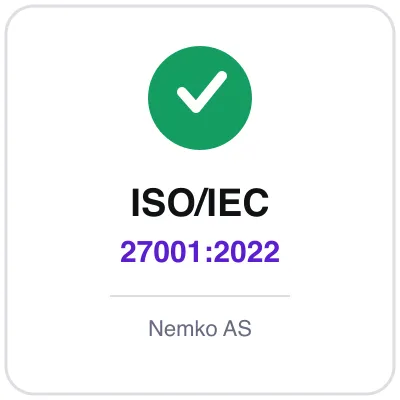
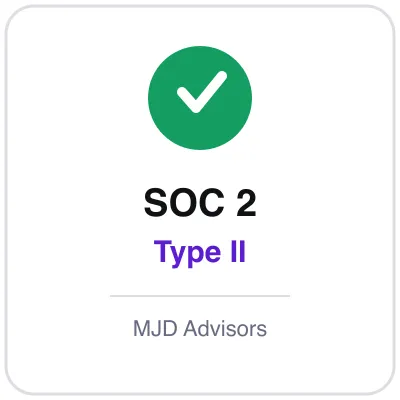
- ISO/IEC 27001:2022 certified (cert BAUT-IS-2026-0471, Nemko AS) and SOC 2 Type II attested (report BAUT-SOC-2026-H1, MJD Advisors).
- Founded 2007, Oslo, Norway. 58 engineers focused exclusively on machine-economy infrastructure. 70 OEM and fleet operator clients.
How machines pay for themselves
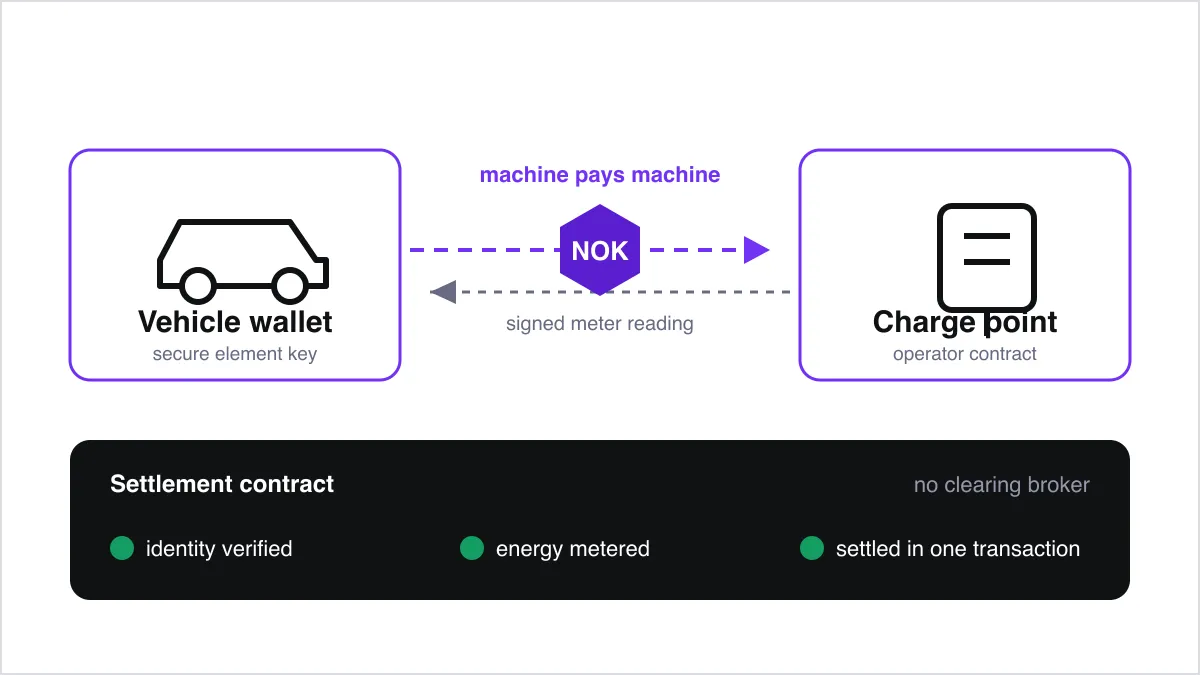
A machine pays for itself in three steps. It is issued a wallet whose key sits in its secure element, its identity is verified on-chain by the service provider's contract, and a usage-based settlement contract releases payment as the service is delivered. No clearing house and no batch reconciliation sit anywhere in that path.
Device wallet issued
Each machine receives a cryptographic key pair stored in its secure element. The wallet and on-chain identity credential are minted at manufacture or commissioning, not at first use.
Identity verified on-chain
The service-provider smart contract checks the machine's on-chain credential: type, operator, compliance status and authorised limits. Roaming across networks works without bilateral agreements.
Settle autonomously
A usage-based settlement contract releases payment in real time as the service is consumed: per kWh delivered, per kilometre driven, per second of compute. The machine pays for itself.
OCPP is the global open communication protocol between charging stations and charging management systems.
What we build
Blockchain Autos ships six things: device wallets and identity, autonomous machine-to-machine payment rails, smart contract engineering, cross-chain machine networks, automotive security and compliance, managed network operation. Each one is priced against one of three published engagement bands, and each one ends with an external audit report the client keeps.
Device wallet and identity
We design and ship device wallet standards, secure-element key provisioning pipelines and on-chain identity credential systems for vehicles, chargers and IoT devices at scale. Our blockchain identity platform covers verifiable credentials development and decentralized identity development so each machine carries a tamper-proof on-chain credential from manufacture to end-of-life.
from NOK 480,000 · fixed-scope build, one device type
Scope a device typeAutonomous M2M payment rails
Usage-based settlement contracts that release micropayments as service conditions are met: per kWh, per toll event, per data packet. Zero batch processing. Instant finality. Our blockchain payments development practice covers the full stack from Web3 payment solutions through stablecoin payment development and Layer 2 architecture so fleet operators choose the settlement economics that fit their transaction volume.
NOK 1,200,000 to NOK 3,400,000 · dedicated platform team
Price a payment railSmart contract engineering
Fleet billing contracts, tokenized service credits, roaming settlement protocols and DeFi-integrated treasury management. All 84 production contracts carry zero critical findings. Our smart contract engineering practice includes smart contract threat modeling, role based smart contracts for access control, upgradeability planning and smart contract audit readiness reviews so every deliverable reaches external audit with confidence.
NOK 16,000 per engineer day · time and materials, audit included
Book engineering timeCross-chain machine network
Multi-chain deployment across Ethereum, Base, Polygon PoS, Arbitrum One, Gnosis Chain, IOTA, Peaq and Solana. One identity, any chain. Tokenization and cross-chain asset bridging included. Cross chain development and bridge integration are first-class concerns: a device wallet provisioned on one network settles autonomously on any supported chain without re-credentialing.
NOK 1,200,000 to NOK 3,400,000 · dedicated platform team, multi-chain
Map your chainsAutomotive security and compliance
ISO/SAE 21434 aligned cybersecurity reviews, UNECE WP.29 compliance, formal smart contract auditing and GDPR DPIA for all personal and vehicle-linked data flows. Secure blockchain development is a baseline requirement here, not an afterthought: we apply smart contract security engineering and key management protocols from day one of every engagement.
NOK 16,000 per engineer day · TARA workshops and audit remediation
Request a TARA reviewManaged machine-economy network
Fully managed M2M settlement infrastructure: node operation, contract upgrades, on-call incident response and a 99.98% uptime SLA. We run the network so you can ship the product. This covers blockchain infrastructure development, node infrastructure and indexer infrastructure for on chain analytics and transaction monitoring so your operations team has full visibility without building the tooling themselves.
from NOK 4,000,000 · plus sustain from NOK 150,000 per month
Discuss managed operationWhy mobility teams choose Blockchain Autos
Nineteen years of automotive and embedded systems work sit behind this stack, which is why the six reasons below are about hardware constraints rather than protocol fashion. Blockchain Autos has shipped 84 production contracts with zero critical findings and holds 3.2 million devices on-chain for 70 mobility operators.
The machine pays for itself
Our rule one: a device that holds a wallet and carries on-chain identity needs no human operator to initiate payment. The EV pays the charger. The truck pays the toll. The robot pays for compute. We build every system to that standard.
Zero critical findings record
All 84 production contracts and integrations we have shipped carry zero critical security findings. NOK 0 in funds has been lost to a Blockchain Autos-shipped contract. We run full audit cycles with external security firms before any production deployment.
Roaming without intermediaries
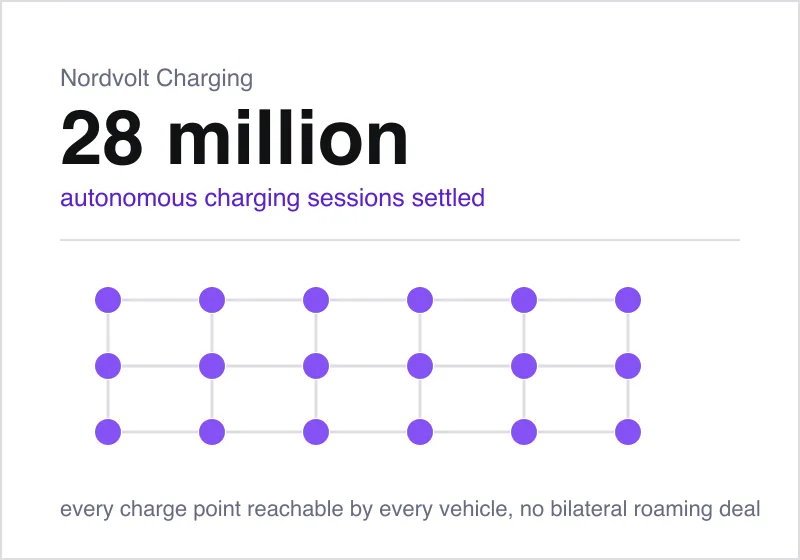
Our on-chain identity and roaming protocol allows a vehicle to pay any network operator it encounters without a pre-existing bilateral clearing agreement. We have validated this across 28 million autonomous charging sessions on the Nordvolt Charging network.
Automotive-grade engineering standards
ISO/SAE 21434 cybersecurity review, UNECE WP.29 compliance, ISO/IEC 27001:2022 certification and SOC 2 Type II attestation. We treat a fleet payment system with the same rigour as flight-critical software.
Production-ready smart contracts
We deliver smart contracts that include formal specification, Foundry fuzzing, external audit co-ordination and a deployment runbook. Not a proof of concept. A production system ready to handle millions of autonomous transactions from day one. Every contract is audit ready and includes maintainable smart contract design so future upgrades can be safely applied without downtime to the device fleet.
58 engineers focused on one niche
Blockchain Autos does not build DeFi exchanges or NFT platforms. We build machine-economy infrastructure. Every engineer on our team understands embedded systems, automotive protocols and on-chain settlement. Depth beats breadth at this layer.
By the numbers
Blockchain Autos is a blockchain development company based in Oslo, Norway that builds the machine economy: device identity and autonomous machine-to-machine payments for connected vehicles, EV charging, fleets and robots. Founded in 2007, it has put 3.2 million devices on-chain and settled NOK 2.4 billion in autonomous machine-to-machine transactions.
Figures are cumulative across all production deployments as of . Verified by external auditors.
Industry context: according to Grand View Research, the global blockchain in automotive market is projected to grow at a compound annual rate above 30% through 2030, driven by connected-vehicle payments, supply-chain provenance and EV charging settlement. The International Energy Agency (IEA) reports that global EV stock surpassed 40 million vehicles in 2023, making autonomous payment infrastructure for charging networks a fast-expanding segment of the machine economy.
Industries we serve
Any industry where a machine must pay for a service without a human in the loop is a machine-economy industry. Blockchain Autos goes deep in four of them: EV charging networks, connected and autonomous fleets, industrial robotics and automation, plus OEM and platform integration work for vehicle manufacturers.
EV charging networks
Vehicle-to-charger autonomous payment. Usage-based settlement per kWh. Cross-network roaming without clearing brokers. Our Nordvolt Charging deployment shows 28 million sessions without a single manual billing intervention.
Connected and autonomous fleets
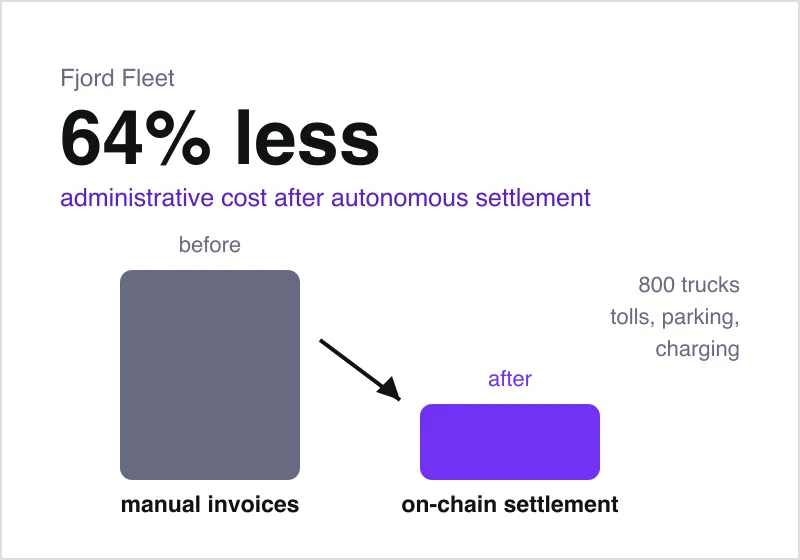
Trucks, vans and autonomous vehicles paying tolls, parking and charging autonomously with on-chain receipts. Fjord Fleet cut administrative overhead by 64% after deploying our fleet payment protocol across 800 vehicles.
Industrial robotics and automation
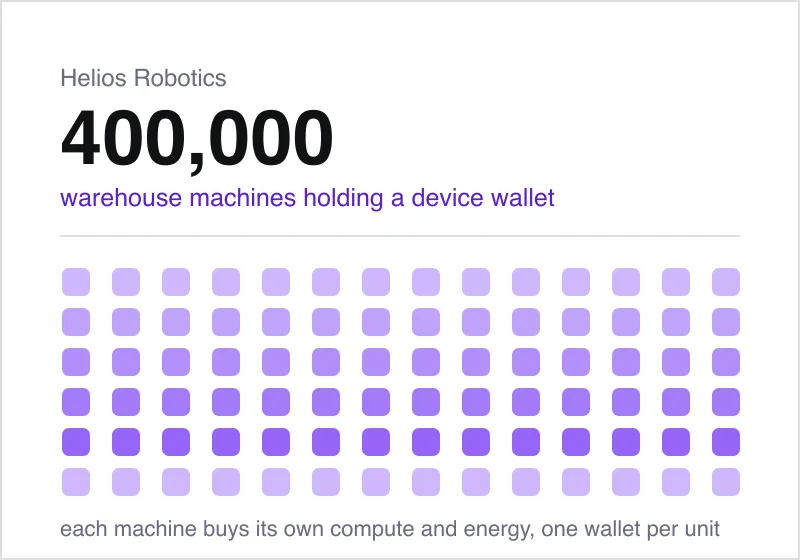
Warehouse robots purchasing compute time, energy and maintenance slots via device wallets. Helios Robotics deployed our protocol across 400,000 machines, enabling fully autonomous inter-robot and robot-to-infrastructure transactions.
OEM and platform integration
Embedding device wallets and machine identity into vehicle platforms at the OEM layer. Connected vehicle blockchain integration, telematics-triggered payment events and asset tokenization of vehicle data and service credits. Enterprise blockchain integration at the OEM layer also includes token system development for loyalty and service-credit programmes built on ERC 20 token development and governed by on-chain access rules.
Technology stack
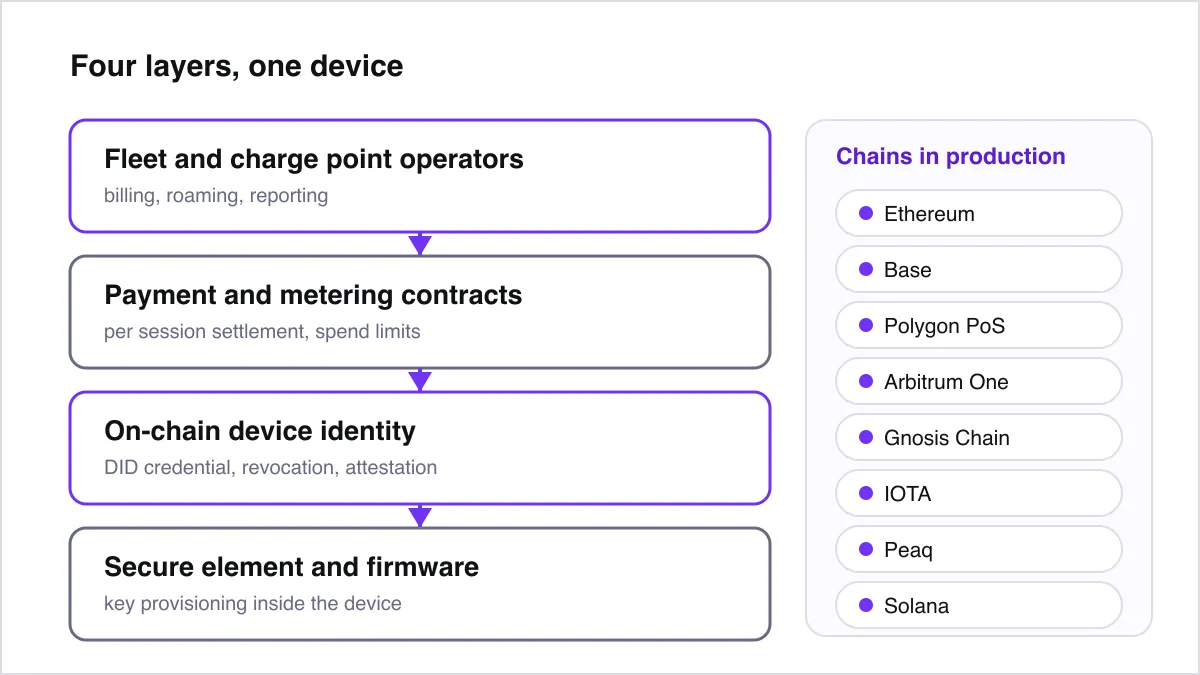
Every layer of this stack is selected for machine-economy performance rather than familiarity: sub-cent transaction cost, sub-second finality on Layer 2 and embedded-grade key management. Eight chains carry production traffic today, and the chain chosen for a deployment is written down at discovery with the reasoning attached to it.
Chains
- Ethereum (settlement, DeFi)
- Base (L2, low gas)
- Polygon PoS (cross-chain)
- Arbitrum One (high-throughput L2)
- Gnosis Chain (stable micropayments)
- IOTA (feeless IoT)
- Peaq (machine DID)
- Solana (high-frequency M2M)
Languages
- Solidity (EVM contracts)
- Rust (Solana programs, embedded firmware)
- C++ (secure-element TEE)
- TypeScript (integration layer)
- Python (tooling)
Frameworks
- Hardhat
- Foundry (Solidity fuzz)
- Anchor (Solana)
- OpenZeppelin Contracts
- ethers.js / viem
Token standards
- ERC-20 (service credits)
- ERC-721 (device identity NFT)
- ERC-4337 (account abstraction)
- ERC-1155 (multi-asset fleet)
- SPL (Solana tokens)
Infra
- The Graph (indexing)
- Chainlink CCIP (cross-chain)
- Tenderly (monitoring)
- Prometheus/Grafana (ops)
- IPFS (credential storage)
DIDs are URIs that associate a DID subject with a DID document allowing trustable interactions associated with that subject.
| Chain | Best for | Finality | M2M suitability | Compliance fit | Typical gas cost |
|---|---|---|---|---|---|
| Ethereum | Settlement layer, DeFi treasury, high-value contracts | ~12 seconds | Low frequency, high value | Mature tooling, wide audit coverage | USD 0.50 to 5.00 per tx |
| Base | EV charging micropayments, consumer-facing L2 | ~2 seconds | High frequency, low value | EVM-compatible, OP Stack audit tooling | Under USD 0.01 per tx |
| Polygon PoS | Cross-chain fleet roaming, multi-operator settlement | ~2 seconds | High frequency, multi-network | EVM-compatible, established audit coverage | Under USD 0.01 per tx |
| Arbitrum One | High-throughput robotics and large fleet deployments | ~1 second | Very high frequency, low value | EVM-compatible, Nitro audit tooling | Under USD 0.01 per tx |
| Gnosis Chain | Stable micropayments, xDAI settlement for mobility | ~5 seconds | Medium frequency, stable settlement | EVM-compatible, established tooling | Fraction of USD 0.01 per tx |
| IOTA | Feeless IoT and EV charging session micropayments | ~10 seconds | Very high frequency, near-zero cost | GDPR-aligned data layer, EU origin | Feeless (protocol subsidy) |
| Peaq | Machine DID, M2M access control, autonomous payment primitives | ~6 seconds | High frequency, IoT-native | Substrate-based, ISO/SAE 21434 aligned tooling | Under USD 0.01 per tx |
| Solana | High-frequency M2M transactions, robot-to-robot payments | ~0.4 seconds | Very high frequency, sub-cent | SPL standard, growing audit ecosystem | Under USD 0.001 per tx |
Protocol integrations and ecosystem partners
Integrations cover oracle feeds, identity registries, security tooling, cross-chain infrastructure and compliance verification. Every partner listed below is in production on at least one Blockchain Autos deployment rather than on a roadmap, and each one can be replaced without reissuing the device credentials already in the field.
Chainlink
CCIP cross-chain messaging and decentralised oracle feeds for real-time energy pricing, toll tariffs and settlement data. Used in production across EV charging and fleet deployments.
IOTA
Feeless directed acyclic graph ledger optimised for IoT and machine-economy transaction volumes. Primary chain for high-frequency per-session EV charging micropayments.
Peaq
Layer 1 purpose-built for the machine economy: device DID, M2M access control and autonomous payment primitives. Used for device identity in Fjord Fleet and Helios Robotics.
The Graph
Decentralised indexing protocol for on-chain event data. Powers the transaction monitoring and analytics dashboards delivered as part of managed-network engagements.
OpenZeppelin
Audited smart contract library and security tooling. Blockchain Autos uses OpenZeppelin Contracts as the base layer for all EVM settlement, access control and upgrade patterns.
Gnosis Safe
Multi-signature contract wallet used for treasury management and operator-controlled contract admin keys. All administrative keys in production deployments use a Gnosis Safe threshold signing model.
Polygon zkEVM
Zero-knowledge EVM rollup providing low-cost EVM-compatible settlement with cryptographic finality guarantees. Evaluated for compliance-sensitive payment flows requiring cryptographic proof of correctness.
Sumsub
Identity verification and AML/KYC platform used for onboarding operators and fleet managers before device wallet provisioning. Integrates into the compliance layer of regulated mobility deployments.
How to choose a blockchain development company for machine economy
Five questions separate a blockchain development company that can carry a machine-economy deployment from one that cannot. They cover production evidence in the buyer's own niche, whether external security audit is mandatory, fluency in automotive cybersecurity standards, ownership of the source code and demonstrated scale at the buyer's own fleet size.
Do they have production deployments in your niche?
Generic blockchain development companies build DeFi and NFT platforms. Machine economy requires device identity, embedded secure elements and high-frequency micropayment economics. Ask for references in connected-vehicle, EV charging, fleet or robotics contexts, not DeFi case studies. Blockchain Autos has shipped 84 production contracts across these verticals with 70 OEM and fleet operator clients.
Is external security audit mandatory, not optional?
Any blockchain development company that ships to mainnet without a signed external audit report is taking risk with your devices and your users' funds. Ask who the audit firm is, whether you receive the full report and whether all critical and high findings are resolved before deployment. Our record is 0 critical findings across all 84 contracts.
Do they understand automotive cybersecurity standards?
ISO/SAE 21434 and UNECE WP.29 are not optional for connected-vehicle and EV charging deployments. If your blockchain development company does not know what a TARA is or cannot describe how UNECE WP.29 affects device wallet design, that is a risk flag. Every Blockchain Autos engagement includes an ISO/SAE 21434 aligned review.
Who owns the IP and source code?
You should own 100% of the source code, smart contracts and documentation delivered in your engagement. Some vendors retain licence rights or use shared codebases. At Blockchain Autos, the client owns 100% of IP and source code. No vendor lock-in. Standard Solidity and Rust deliverables you can maintain or migrate with any team.
Can they scale with your device fleet?
A device wallet that works for 100 vehicles must also work for 400,000 without redesign. Ask about gas economics at scale, their L2 selection rationale and whether they have tested at the transaction volumes your fleet will generate. Our Helios Robotics deployment runs 400,000 devices on Arbitrum One and Peaq with sub-cent transaction costs.
| Sourcing route | Cost profile | Time to first line of code | External audit access | Bus factor | Retention risk |
|---|---|---|---|---|---|
| In-house team | Fixed salary cost that continues after the build ends | 3 to 9 months, hiring embedded and contract engineers who are scarce in the same person | Arranged and paid separately, often after the code is written | High, since the design usually lives with one or two people | The knowledge leaves when they do |
| Specialist agency | Fixed price per phase, no cost after handover | Days, from a bench that has shipped the same pattern before | Booked as part of the engagement and priced inside it | Low while the contract runs, since more than one engineer holds the design | Real at handover, which is what the runbook and the sessions exist to close |
| Freelance contractors | Lowest day rate, highest variance in total cost | Days to weeks, depending on availability | Rarely included and rarely budgeted for | Highest, since each contractor holds only their own part | Highest, with no obligation to be available for the next incident |
Blockchain Autos is the middle row and the weakness of that row is the handover, not the build. That is why every engagement exits with a deployment runbook, a threat model, knowledge-transfer sessions and 100% of the source code under the client's own ownership, and why the audit fee sits inside the fixed price rather than in a budget line that can be cut.
Engagement models and pricing
Three engagement models cover different stages: a fixed-scope build, a dedicated platform team and a managed network with sustain. All amounts are quoted in NOK, every contract includes a production readiness gate before mainnet deployment, and the external audit fee is carried inside the fixed price rather than billed as an extra.
Device-wallet integration
Scoped device-wallet and identity integration for a defined vehicle or device type. Includes secure-element key provisioning, on-chain identity credential, smart contract and deployment runbook.
Start a conversationFull M2M payments and identity platform
End-to-end M2M payment and identity platform for a fleet or charging network. Includes multi-chain deployment, roaming protocol, fleet billing contracts, tokenization layer, audit and managed rollout.
Talk to our engineersManaged machine-economy network
Fully managed machine-economy network: node operation, smart contract upgrades, on-call incident response and a 99.98% uptime SLA. We run the infrastructure so your team ships the application.
Talk to our engineersOur commitments to every client
- Free 2-hour scoping session before any commitment
- Fixed-price discovery phase at NOK 16,000 per day with a written scope output
- You own 100% of IP and source code: standard Solidity and Rust, no proprietary lock-in
- Audit-pass commitment: all critical and high findings resolved before mainnet deployment
- No vendor lock-in: deliverables use open standards (W3C VC, EIP-4337, Solidity, Rust)
- Defined exit package: deployment runbook, handover sessions and full documentation so your team can maintain the system independently
What drives engagement cost
Five factors that determine where your engagement falls within the pricing bands above. The Discovery phase produces a written scope estimate before any code is written.
Number of device types and chains
Each device type requires a distinct key provisioning pipeline and identity credential model. Each additional chain multiplies integration and audit scope. A single-device, single-chain integration is the fastest path to production.
Audit scope and contract complexity
External audit cost scales with contract line count and business logic complexity. Simpler settlement contracts with fewer upgrade paths cost less to audit. Our Discovery phase produces a complexity estimate before any code is written.
Roaming and cross-network requirements
Supporting vehicle roaming across multiple charging networks or toll operators multiplies the identity and settlement surface. Each new network operator requires credential validation and settlement logic.
Regulatory compliance depth
ISO/SAE 21434 TARA reviews, UNECE WP.29 design reviews, GDPR DPIAs and AML/KYC integration each add scope. The more regulated your deployment environment, the more compliance engineering is required.
Managed network vs client-operated
Handing network operations to Blockchain Autos (managed model from NOK 4,000,000) removes DevOps cost from your team but adds ongoing monthly fees. Client-operated deployments include a full deployment runbook and knowledge-transfer sessions.
| Deliverable | Our price (NOK) | Typical market range (USD) | Source |
|---|---|---|---|
| Discovery and architecture engagement | NOK 16,000 per engineer day | $5,000 to $20,000 | Reown |
| Device wallet and identity integration | from NOK 480,000 | no published range for this deliverable | no verified source |
| Token standards and credential contracts | inside NOK 1,200,000 to NOK 3,400,000 | $20,000 to $80,000 | Reown |
| Cross-chain machine network | inside NOK 1,200,000 to NOK 3,400,000 | $30,000 to $120,000 | Reown |
| Operator console and dApp MVP | inside NOK 1,200,000 to NOK 3,400,000 | $5,000 to $20,000 and up | Cleveroad |
| External audit of one settlement contract | quoted by the audit firm, paid inside the fixed price | $5,000 to $250,000 | Sherlock |
| Node and infrastructure setup | inside the managed network from NOK 4,000,000 | $2,000 to $5,000 and up, public chain | Cleveroad |
| Sustain retainer, monthly | from NOK 150,000 per month | $5,000 to $15,000 per month | Alchemy |
Market ranges as published by Sherlock, Reown, Cleveroad and Alchemy, each checked on . Audit fees are quoted by the audit firm and paid by Blockchain Autos inside the fixed price, which is why 84 production contracts have shipped with zero critical findings against them rather than an audit line the client is asked to fund separately.
| Feature | Fixed-scope build | Dedicated platform team | Managed network |
|---|---|---|---|
| Scope definition | Fixed: one device type, one chain | Negotiated: multi-device, multi-chain | Full: end-to-end network plus operations |
| External security audit | Included | Included | Included plus ongoing audit cycles |
| IP ownership | 100% client | 100% client | 100% client |
| Timeline | 8 to 12 weeks | 4 to 8 months | 6 to 12 months |
| Sustain included | Optional add-on from NOK 150,000/month | Optional add-on from NOK 150,000/month | Included in managed network fee |
| Best for | First device-wallet integration for a defined vehicle type | New M2M payment platform for a fleet or charging network | Operators who want Blockchain Autos to run the network long-term |
Autonomous M2M vs intermediary billing
Intermediary billing settles in batches through a clearing party that prices the risk of collecting later. Autonomous machine-to-machine settlement prices the service as it is delivered and records the payment against a signed meter reading. The table below compares the two across cost, latency, dispute rate and audit trail.
| Dimension | Blockchain Autos M2M | Traditional intermediary billing |
|---|---|---|
| Settlement speed | Instant on-chain finality per kWh or event | 24 to 72 hours batch reconciliation |
| Intermediary cost | On-chain gas only (sub-cent per transaction on L2) | 3 to 7% clearing broker fee per transaction |
| Roaming support | Any network via on-chain identity, no bilateral contract needed | Bilateral clearing agreements required per operator |
| Transparency | Every transaction on-chain, auditable by all parties | Opaque clearing statements, dispute resolution manual |
| Micropayment support | Per-second, per-kWh, per-event with L2 economics | Minimum transaction floor of EUR 0.10 or higher |
| Human approval steps | Zero: fully autonomous machine-to-machine | Batch approval, reconciliation team, dispute handling |
| DeFi integration | Native: yield, liquidity and tokenization built in | Not applicable |
Case studies
Three production deployments show the same architecture at three different scales: a Nordic EV charging network settling 28 million autonomous sessions, a Norwegian logistics fleet whose administrative cost fell 64 percent and 400,000 warehouse robots buying their own compute and energy directly from the machines that supply it.
- Challenge
- Nordvolt operates a multi-network EV charging infrastructure across Scandinavia. Vehicles from any OEM needed to pay chargers across networks without a roaming clearing broker.
- What we did
- Blockchain Autos built a device-wallet and M2M settlement layer on Base and IOTA that lets vehicles pay chargers directly, session by session. The smart contract architecture applies scalable blockchain development principles so throughput scales with the charger estate without redeployment.
- Result
- 28 million autonomous charging sessions, instant settlement per kWh and cross-network roaming without bilateral agreements.
- Challenge
- Fjord Fleet operates 800 heavy trucks across Norway. Toll payments, parking fees and EV charging were handled by a back-office accounts team processing invoices manually.
- What we did
- Blockchain Autos deployed on-chain device wallets for each vehicle and autonomous payment contracts for toll gates, parking operators and chargers. The engagement is a textbook example of enterprise blockchain integration: existing fleet management systems remained in place while blockchain backend development added an autonomous settlement layer underneath.
- Result
- Administrative cost fell 64%. Every payment is now settled on-chain with an immutable audit trail and no manual reconciliation step.
- Challenge
- Helios operates a network of 400,000 warehouse robots across EU distribution centres. Robots needed to purchase compute capacity, energy and maintenance slots from other machines and infrastructure services.
- What we did
- Blockchain Autos deployed device wallets and a machine-to-machine micropayment protocol on Arbitrum One and Peaq. The protocol uses Layer 2 development to keep gas costs below one cent per transaction even at 400,000-robot scale. Digital asset software development also covered a tokenized maintenance-slot marketplace where robots bid for service time using on-chain credits.
- Result
- Robots now transact autonomously for compute and energy across all 400,000 machines, with on-chain receipts and usage-based settlement per transaction.
Delivery path
Four phases run from first call to production mainnet: discovery, an engineering sprint, an external security audit and production handover. No phase advances without written sign-off from both sides and the audit is a gate rather than a milestone. A device-wallet integration completes the whole path in 8 to 12 weeks.
Discovery
Device audit, chain selection, identity model, settlement logic specification. This is blockchain technical discovery in the fullest sense: we map device firmware, network topology and payment flows before a line of code is written. 3 to 4 weeks. Fixed NOK 16,000 per day.
Engineering sprint
Device wallet, smart contracts and integration code. Internal fuzzing with Foundry and symbolic execution. Our blockchain test automation and smart contract CI CD pipelines enforce coverage thresholds before the go/no-go gate. Blockchain QA is a gating criterion, not a post-delivery step.
Security audit
External audit with a named security firm. We target zero critical findings before signing off on mainnet deployment. Smart contract deployment to production requires a signed audit report with all critical and high findings resolved. Co-ordinated remediation included.
Production and sustain
Mainnet deployment with deployment runbook. Monitoring, alert routing and on-call from day one. Optional managed-network handover. Web3 DevOps practices cover node infrastructure, on chain data APIs and indexer infrastructure so your team has live visibility into every autonomous transaction from launch.
Milestones, payment and exit
Blockchain Autos invoices against four delivery milestones rather than a monthly burn, so a client pays for a signed-off phase and never for work in progress. Every engagement carries the same exit terms, and a stopped project is settled pro rata within fourteen days.
Milestone schedule
- On signature
- 30% of the fixed price, releasing the Discovery phase
- Engineering go or no-go gate
- 40%, invoiced once the coverage gate is passed and the audit firm is booked
- Audit sign-off
- 20%, invoiced against the signed external report
- Production handover
- 10%, invoiced with the runbook and the handover sessions completed
Payment terms
- Invoices are due net 14 days from issue, in NOK, with Norwegian VAT added where it applies.
- Time-and-materials work is billed monthly in arrears at NOK 16,000 per engineer day against a signed timesheet.
- Sustain retainers from NOK 150,000 per month are invoiced quarterly in advance and cancellable on 60 days notice.
- External audit fees are quoted by the audit firm and carried inside the fixed price, which is how 84 production contracts reached mainnet with zero critical findings outstanding.
If the project stops
- Either side may stop the engagement in writing at the end of any phase, with no exit fee and no minimum term.
- Work completed to date is invoiced pro rata against the milestone schedule above, and work not started is never invoiced.
- Source code, deployment keys, device provisioning material and documentation are handed over within 5 business days of the final invoice.
- Intellectual property in everything delivered belongs to the client from the moment it is paid for, as the commitments above already state.
Deliverables
Every engagement produces the same defined set of audited and documented outputs, and the client owns 100 percent of the intellectual property and the source code. Deliverables are built on open standards, so nothing in the delivered stack needs a Blockchain Autos licence or a Blockchain Autos engineer to keep running.
- Audited Solidity and/or Rust source code (all critical and high findings resolved before mainnet deployment)
- Device-wallet integration library (TypeScript SDK with embedded signing interface)
- On-chain identity credential specification (W3C VC compatible, hardware-anchored)
- External audit report (signed, from named security firm, with full finding log)
- Deployment runbook (step-by-step mainnet deployment and rollback procedures)
- Threat model document (STRIDE-based, ISO/SAE 21434 aligned)
- API and SDK documentation (full OpenAPI spec, integration guide)
- Knowledge-transfer sessions (recorded, structured handover to client team)
Engineering team
Blockchain Autos fields 58 engineers across seven specialist roles, and the firm builds no DeFi exchanges and no NFT platforms. Every engineer works on embedded systems, automotive protocols and on-chain settlement together, because a device wallet fails at the seam between firmware and contract far more often than inside either one.
Protocol Architect
Designs device identity standards, credential schemas and cross-chain settlement protocols. Ensures protocol decisions hold at millions-of-devices scale.
Smart Contract Engineer
Writes, fuzz-tests and deploys EVM and Solana programs. Specialises in usage-based settlement logic, access control and upgradeability patterns.
Embedded Systems Engineer
Integrates device wallet and signing logic into vehicle ECUs and IoT hardware secure elements. Bridges the embedded and blockchain layers.
Security and Audit Lead
Leads internal security reviews, co-ordinates external audit engagements and ensures all critical and high findings are resolved before mainnet. Maintains the zero critical findings record.
Compliance Specialist
Manages ISO/SAE 21434 TARA reviews, UNECE WP.29 design compliance, GDPR DPIAs and AML/KYC integration for regulated mobility deployments.
Integration Engineer
Builds the integration layer between on-chain infrastructure and OEM telematics, fleet management and ERP systems. Works across TypeScript, REST and event-driven architectures.
DevOps and Infrastructure Engineer
Operates node infrastructure, deployment pipelines, monitoring and alerting for managed-network clients. Maintains the 99.98% uptime SLA.
Founder
Charlotte Bennett founded Blockchain Autos in 2007, after a decade spent in automotive embedded systems and connected-car telematics. She holds an MEng in Electrical and Information Engineering from the University of Cambridge, and her work covers device identity, secure elements, machine-to-machine micropayments and autonomous agent settlement in production fleets.
Charlotte Bennett founded Blockchain Autos in 2007 following a career as an embedded systems engineer at a Tier-1 automotive supplier and then leading connectivity engineering at a connected-car and telematics company. Her research specialism is device identity, embedded secure elements, M2M micropayments and autonomous-agent settlement.
Charlotte holds an MEng in Electrical and Information Engineering from the University of Cambridge (2008). She has published research on device identity standards, autonomous settlement protocols and usage-based micropayment economics in machine-economy deployments.
"In 2018 I was leading an EV-charging roaming project. Every charging network had its own closed billing platform. A car from operator A could not pay operator B's charger without a clearing broker taking 5%. I built a device wallet and M2M settlement layer so the vehicle could pay the charger directly. From that day, rule one became: let the machine pay for itself."
Research note
Blockchain Autos publishes technical research on machine-economy protocols, autonomous settlement design and connected-vehicle architecture. Research note BAUT-2026-05 runs to 28 pages and reports that 79 percent of mobility transaction cost was intermediary fees and reconciliation overhead, a layer autonomous settlement removed for a 91 percent cost reduction.
The Machine Economy: Device Identity and Autonomous Settlement for Connected Vehicles
This note analyses 52 connected-vehicle and fleet deployments to quantify the full cost of intermediary-based billing. The finding: 79% of mobility transaction cost was intermediary fees and batch reconciliation overhead. After switching deployments to autonomous M2M settlement, settlement cost fell 91%. The paper describes the device identity standard, on-chain credential model and usage-based settlement contract architecture used across the Blockchain Autos production portfolio. It also benchmarks on chain development patterns across eight chains and documents the connected vehicle blockchain architecture choices that most influence settlement latency at high transaction volumes. Verifiable credentials development and DID development approaches are evaluated against three production identity registries.
AI meets the machine economy
Autonomous systems become more capable when the decision layer and the settlement layer sit together. In each pattern below the model proposes and the contract disposes: spending limits, counterparty allow-lists and per-transaction caps are enforced on-chain, where a wrong prediction costs a suboptimal route rather than an unbounded payment.
On-chain AI agents for autonomous vehicle decisions
AI agents embedded in vehicle firmware evaluate route costs, energy prices and service availability, then execute on-chain payment decisions autonomously. The agent holds a bounded device wallet with per-transaction limits enforced by smart contract, so the AI can only spend within operator-approved parameters.
ML-based anomaly detection for M2M payment fraud
Machine learning models trained on historical M2M transaction patterns flag anomalous payment requests before they hit the settlement contract. Suspicious device wallets are rate-limited or suspended on-chain without manual intervention, protecting the settlement pool in real time.
AI oracles for real-time energy and toll pricing
Smart contracts for EV charging and toll settlement require live pricing data. AI-powered oracle services aggregate real-time grid energy prices, toll tariffs and congestion signals and push them on-chain with cryptographic attestation, so settlement contracts always use the current market price.
LLM-driven fleet route optimisation settled on-chain
Large language model planners optimise fleet routes based on toll cost, charging availability and delivery windows. The route selection triggers pre-authorised on-chain payment commitments for each stop: toll gates, chargers and parking operators receive autonomous payments as the vehicle follows the AI-planned route.
Reviews
Blockchain Autos holds 46 verified reviews across Clutch and G2, written by mobility operators, fleet managers and OEM engineering teams. The two platform scores are reported separately below because they count different reviewers, and every review names the platform it was left on and the month it was written.
Vehicles pay chargers directly. 28 million sessions without a single billing dispute. That was unthinkable two years ago. The Blockchain Autos team built something that genuinely works at scale and they held zero critical findings through the full external audit.
Our trucks now pay tolls and charging autonomously. Administrative overhead down 64%. We have an immutable on-chain receipt for every transaction and our accounts team handles exceptions instead of processing every invoice. The ROI was clear within the first quarter.
400,000 machines transacting for compute and energy autonomously with zero human approval steps. We tried two other vendors before Blockchain Autos. Nobody else understood embedded secure elements and M2M micropayments at this depth. The protocol has run without a critical incident.
Instant settlement across every charging session. No batch reconciliation, no roaming broker, no three-day payment windows. Our connected vehicle platform now settles in real time and the driver never sees a billing error. This is what the machine economy should look like.
We needed a blockchain development company that understood automotive-grade security requirements, not just smart contracts. ISO/SAE 21434 alignment, UNECE WP.29 design review, SOC 2 attestation. They delivered the full compliance stack alongside the payment protocol. Exceptional engineering rigour.
Platform scores are read from the public Clutch and G2 profiles and were last checked on . The two scores are reported separately because they count different reviewers, and the aggregate rating in this page's structured data is the review-weighted mean of the two.
Certifications and awards
Third-party verified certifications cover information security, automotive cybersecurity and privacy. Every certificate number and issuing body is printed so a procurement team can check it independently. The set includes ISO/IEC 27001:2022, a SOC 2 Type II attestation, ISO/SAE 21434 alignment and a completed GDPR data protection impact assessment.
 ISO/IEC 27001:2022
 SOC 2 Type II
 ISO/SAE 21434
 UNECE WP.29
 GDPR DPIA
 Clutch Top Blockchain 2026
 G2 High Performer 2026
 Oslo Mobility Tech Award 2025
 EU Machine Economy Finalist 2025
Security and compliance
Every engagement is governed by automotive-grade security standards and exits with a signed external audit report rather than a self-assessment. The record behind that claim is 84 production contracts with zero critical findings and NOK 0 lost to a shipped contract, across 3.2 million devices and 1.7 billion autonomous transactions.
Regulatory frameworks
- ISO/SAE 21434: automotive cybersecurity engineering standard applied across all smart contract and firmware deliverables
- UNECE WP.29: vehicle cybersecurity regulation governing device wallet and connected-vehicle identity design
- GDPR: data protection regulation applied to all vehicle-linked personal data flows via mandatory DPIA
- AML/KYC: identity verification requirements for M2M payment wallets handling regulated value flows
- ISO/IEC 27001:2022 cert BAUT-IS-2026-0471, issued by Nemko AS, Norway
- SOC 2 Type II report BAUT-SOC-2026-H1, attested by MJD Advisors
Security track record
Manufacturers can help their customers by improving how securable the IoT devices they make are
Where our engineers publish and speak
Blockchain Autos engineers contribute to machine-economy research and speak at industry events, publishing across the outlets listed below. The work covers autonomous settlement design, device identity schemes and the automotive cybersecurity standards that govern them, and it feeds directly back into the protocols the firm ships to production.
Frequently asked questions
Twelve questions cover what a machine-economy blockchain build costs, how long it takes, how a vehicle pays a charger with no broker in between, how a device identity is issued and revoked and what happens when a device key is compromised. Each answer is written to stand on its own.
What does a blockchain development company do in the machine economy?
A blockchain development company designs, builds and deploys the smart contracts, key material and on-chain infrastructure a business needs to move value on a distributed ledger. Blockchain Autos works on one part of that field: the machine economy, where the account holder is a vehicle, a charger, a truck or a warehouse robot rather than a person.
In practice the work spans four layers. Firmware and secure-element key provisioning inside the device, an on-chain identity credential that says what the device is and what it may spend, payment and metering contracts that release funds as a service is delivered, and the operator systems that read the result. Blockchain backend development, multi chain development and blockchain infrastructure development all sit inside that stack.
It is not consumer wallet work and it is not token issuance for its own sake. A machine cannot re-enter a seed phrase, approve a pop-up or call support, so every design decision is about what happens when nobody is watching. That constraint is why Blockchain Autos has kept to this niche since 2007 rather than taking general Web3 software development work.
How much does a device wallet and M2M payment build cost?
A scoped device-wallet and identity integration for one device type starts from NOK 480,000. A full M2M payments and identity platform for a fleet or charging network runs from NOK 1,200,000 to NOK 3,400,000. A managed machine-economy network starts from NOK 4,000,000, and sustain retainers start from NOK 150,000 per month. Time-and-materials work is NOK 16,000 per engineer day.
Five things move a quote inside those bands: how many device types need their own provisioning pipeline, how many chains the settlement layer has to reach, whether an existing fleet or billing system has to stay in place, how much automotive compliance evidence the deployment needs, and whether Blockchain Autos operates the network afterwards or hands it over.
The external security audit is quoted by the audit firm and carried inside the fixed price rather than billed to the client as an extra line. That is a deliberate commercial choice: an audit a client can decline is an audit that gets declined, and 84 production contracts have reached mainnet with zero critical findings against them precisely because it never was optional.
How long does a device wallet and M2M payment build take?
Discovery and device-wallet scoping takes 3 to 4 weeks. A production device-wallet integration takes 8 to 12 weeks from first call to mainnet, split across discovery, a 3 to 5 week engineering sprint, 1 to 2 weeks of external audit and a week of production handover. A full M2M payments and identity platform takes 4 to 8 months including the audit, and a managed machine-economy network 6 to 12 months including pilot deployment and OEM integration.
What stretches a timeline is almost never the smart contract. It is hardware access: getting a real device on a bench, getting the secure element provisioning path signed off by the manufacturer, and getting a test charger or toll gate that will accept a payment from a wallet nobody has seen before. Projects that start with device access already arranged finish at the short end of every band above.
No phase advances without written sign-off from both sides, and the security audit is a gate rather than a milestone that can be moved. A client who needs a demonstration sooner than the full path allows normally takes the discovery phase on its own, which produces a written settlement specification and a chain selection that stays valid whether or not the build continues.
How does vehicle-to-charger autonomous payment work?
The vehicle holds a device wallet: a cryptographic key pair stored in its secure element. When a charging session starts, the vehicle's on-chain identity is verified by the charger's smart contract before any energy flows. As kWh are delivered, a usage-based settlement contract releases micropayments from the vehicle wallet to the charger operator in real time.
There is no human action in the path, no clearing broker taking a percentage and no batch reconciliation at the end of the month. The charger publishes a signed meter reading, the contract prices it and the payment settles in the same transaction. Both sides hold an on-chain receipt that neither can edit afterwards, which is what removes the billing dispute rather than resolving it faster.
Our Nordvolt Charging deployment has processed 28 million autonomous charging sessions on this model across Base and IOTA. The same pattern applies unchanged to toll gates, parking operators and compute providers, because from the contract's point of view a kWh, a kilometre and a second of compute are the same kind of metered unit.
What is a device wallet in the machine economy?
A device wallet is a cryptographic key pair and on-chain account held directly by a physical device: a car, charger, truck or robot. The private key lives in the device's secure element or trusted execution environment and never leaves it. The wallet lets the device sign and broadcast blockchain transactions autonomously, paying for services and receiving payment without routing through a human-operated payment processor.
Key management and permission design are the two decisions that matter most at this layer. A key lifecycle with no revocation path leaves a stolen device spending indefinitely, and a transaction limit set too high turns one compromised unit into a fleet-wide loss. Blockchain Autos designs both at discovery, before any contract is written, because neither can be retrofitted onto devices already in the field.
A device wallet is also an accounting object, not only a security one. Once every machine has its own account, an operator can see what each unit costs to run per kilometre or per shift without an allocation model, because the machine paid for its own energy, tolls and compute directly and the ledger recorded each payment against it.
Which blockchain networks do you support for M2M payments?
Blockchain Autos supports Ethereum, Base, Polygon PoS, Arbitrum One, Gnosis Chain, IOTA, Peaq and Solana. Chains are selected per project against transaction cost, finality time and ecosystem fit rather than by preference, and the selection is written down at discovery with the reasoning attached.
IOTA and Peaq suit machine-economy workloads because they are built for high-frequency low-value device transactions. EVM development on Ethereum and its Layer 2 networks suits deployments that need deep DeFi integration or a liquid token market. Gnosis Chain suits stable-value settlement where the operator does not want price exposure between the meter reading and the payment.
Multi chain development across two or more networks is normal for large fleet operators who need roaming coverage across regional ecosystems. The identity credential is issued once and verified on each chain the fleet touches, so adding a chain later is an integration task rather than a re-issue of every device credential in the field.
How do you handle device identity for connected vehicles and fleets?
Each device is issued a verifiable on-chain credential that encodes its type, its operator, its regulatory compliance status and its authorised transaction limits. Identity is anchored to a hardware secure element at the device and verified on-chain by service-provider smart contracts before any transaction is authorised.
The scheme is ISO/SAE 21434 aligned and designed for roaming, so a vehicle can pay a charger or a toll gate on any supported network without a pre-existing bilateral agreement between its operator and that service provider. The credential answers the only two questions the service provider actually has: is this device what it claims to be, and is it allowed to spend this much.
Credentials are revocable and attestable. An operator can revoke a single unit within one block if it is sold, scrapped or stolen and can attest a fleet-wide compliance status to an auditor without exposing per-vehicle movement data. Decentralized identity development and verifiable credentials development are the two disciplines this layer draws on.
What is your approach to automotive cybersecurity compliance?
Every smart contract and device firmware integration Blockchain Autos ships is reviewed against ISO/SAE 21434 automotive cybersecurity engineering requirements and UNECE WP.29 vehicle regulation. The threat analysis and risk assessment is produced during discovery and updated at each phase gate rather than assembled at the end for the file.
The company holds ISO/IEC 27001:2022 certification under certificate BAUT-IS-2026-0471 issued by Nemko AS, a SOC 2 Type II attestation reported as BAUT-SOC-2026-H1 by MJD Advisors, and completes a GDPR data protection impact assessment for every deployment that touches personal or vehicle-linked data.
The record behind that is 84 production contracts with zero critical findings and NOK 0 lost to a Blockchain Autos-shipped contract. Compliance evidence is delivered as artefacts the client keeps: the threat model, the audit report, the DPIA and the deployment runbook, so an OEM procurement review can be answered without coming back to us for paperwork.
What should I ask when evaluating a blockchain development company for machine economy?
Ask five questions. Does the company have production deployments in vehicle, EV charging, fleet or robotics contexts, with names and numbers attached? Is external security audit mandatory before mainnet or optional? Does the team understand ISO/SAE 21434 and UNECE WP.29? Who owns the source code and the IP? Can they show scale at your own fleet size?
Ask two more that most buyers forget. What happens to the device keys if the engagement ends early, and what does the exit package contain? A supplier who cannot describe the handover in concrete terms is describing a dependency, not a delivery.
A blockchain development company that cannot answer all seven with specific examples is unlikely to deliver production machine-economy infrastructure. Blockchain Autos declines engagements where the answers would be thin, which is why the portfolio is 70 operators rather than several hundred.
What is included in a blockchain development company engagement at Blockchain Autos?
Every engagement delivers audited Solidity or Rust source code, a device-wallet integration library, an on-chain identity credential specification, a signed external audit report, a deployment runbook, a threat model document, full API and SDK documentation and knowledge-transfer sessions with the client's own engineers.
The client owns 100% of the IP and source code. Deliverables use open standards, W3C verifiable credentials, EIP-4337, Solidity and Rust, so nothing in the stack requires a Blockchain Autos licence or a Blockchain Autos engineer to keep running after handover.
Commercially, the work is invoiced against four milestones rather than a monthly burn: 30% on signature, 40% at the engineering gate, 20% at audit sign-off and 10% at production handover. Either side can stop at the end of any phase with no exit fee, and everything delivered is handed over within 5 business days of the final invoice.
How does AI integrate with blockchain development for connected vehicles?
Blockchain Autos integrates AI with on-chain infrastructure in four ways. On-chain AI agents execute autonomous payment decisions inside smart-contract-enforced spending limits. ML-based anomaly detection flags fraudulent M2M payment requests before they settle. AI oracles push real-time energy and toll pricing on-chain with cryptographic attestation. LLM-driven route optimisation triggers pre-authorised payments at each stop.
The design rule across all four is that the model proposes and the contract disposes. An agent may choose which charger to use, but the spending limit, the counterparty allow-list and the per-transaction cap are enforced on-chain where the model cannot reach them. A wrong prediction then costs a suboptimal route rather than an unbounded payment.
This matters more for machines than for people because there is no confirmation dialog to catch the mistake. The settlement contract is the last line of defence, so it is written to be legible to an auditor rather than clever, and every autonomous decision leaves an on-chain record showing what was paid, to whom and against which meter reading.
What happens if a device is stolen or its key is compromised?
The credential is revoked on-chain, and from the next block every service provider that checks it declines the device. Revocation is part of the identity design from the start rather than an operational workaround, because a machine cannot be asked to change its password and a fleet cannot be recalled to a depot to be re-flashed.
Exposure before revocation is bounded by the limits written into the wallet at provisioning: a per-transaction cap, a rolling spend ceiling and an allow-list of counterparty contract addresses. A stolen truck can buy the energy a truck plausibly needs and nothing else, which is what keeps a single compromised unit from becoming a fleet-level loss.
The private key itself stays inside the secure element and is never exported, so a compromise means possession of the device rather than possession of the key. Replacing the unit issues a new credential against the same operator account, and the on-chain history of the old one stays readable for the insurance claim and the incident report.
Glossary
Ten terms define the vocabulary this page uses: the device wallet, the on-chain identity credential, machine-to-machine settlement and the rest of the machine-economy stack. Each definition describes how the term is used inside Blockchain Autos deployments and research rather than how the industry uses it in general.
Machine economy glossary (10 terms)
- Machine economy
- An economic system in which machines, devices and autonomous agents transact directly with one another without human intermediaries, holding wallets, carrying on-chain identity and settling in real time. Building machine economy infrastructure requires on chain development practices that differ substantially from conventional enterprise blockchain development: transaction volumes are orders of magnitude higher and latency budgets are sub-second.
- Device wallet
- A cryptographic key pair and on-chain account held directly by a physical device such as a vehicle or robot, enabling the device to sign and broadcast transactions autonomously.
- Machine identity
- A verifiable on-chain credential that proves a device is what it claims to be: its type, operator, compliance status and authorised transaction limits, used to gate access to services and networks.
- M2M payment
- A machine-to-machine payment: a value transfer settled directly between two devices on-chain without routing through a human-operated payment processor or clearinghouse.
- Autonomous settlement
- The process by which a smart contract finalises a payment between two devices the moment a service condition is met, with no manual approval, batch reconciliation or counterparty risk window. DeFi risk controls and oracle integration are both relevant here: price feeds and service-condition oracles must be tamper-resistant for the settlement to be trustworthy.
- Micropayment
- A payment of very small value, typically fractions of a token, used in machine-economy contexts to pay for per-second electricity delivery, per-kilometre road access or per-query data feeds.
- Roaming
- The ability of a vehicle or device to access services on a network it does not have a direct billing relationship with, paid autonomously via on-chain identity and M2M settlement rather than through a clearing broker.
- Telematics
- Vehicle telemetry and connectivity systems that transmit usage, location and diagnostics data. When combined with a device wallet, telematics events can trigger autonomous on-chain payments. Connected vehicle blockchain architecture relies on telematics pipelines as the event source for usage-based settlement; blockchain analytics and on chain analytics tools then provide operators with full auditability across every triggered payment.
- Edge device
- A computing device deployed at the network edge, such as a vehicle ECU, EV charger or warehouse robot, that runs signing and transaction logic locally without depending on a central server.
- Usage-based settlement
- A payment model in which the amount settled is computed in real time from actual consumption data, such as kilowatt-hours delivered or seconds of charging, rather than from a pre-negotiated flat tariff. Token vesting contracts and tokenization platform development extend this model to longer-horizon agreements: a vehicle operator can pre-purchase charging credits as tokens that vest into the payment pool as sessions are consumed.
Contact
Blockchain Autos takes on a limited number of new clients each quarter and answers every enquiry within one business day. The office is in Oslo with a satellite in Stuttgart, reachable Monday to Friday between 09:00 and 17:00 CET, and every engagement opens with a free two-hour scoping session.
Org. 924 681 037 · VAT: NO 924 681 037 MVA
Dronning Eufemias gate 8
0191 Oslo, Norway
Satellite office: Konigstrasse 28, 70173 Stuttgart, Germany
Mon–Fri 09:00–17:00 CET
Start a conversation
We take on a limited number of new clients each quarter. If you are building connected-vehicle, EV charging, fleet or robotics infrastructure and want to explore autonomous M2M payments, get in touch early. We are a blockchain technology partner that brings full cycle blockchain development from device firmware integration through smart contract deployment and managed network operations. We will respond within one business day.
Email our engineersEditorial policy
Accuracy and verification
All statistics, case study metrics and client quotes published on this page are sourced from production deployment records and verified by Blockchain Autos AS. Metrics are updated semi-annually. The research note BAUT-2026-05 is available on request.
Review policy
Client testimonials are collected via verified post-project surveys. Aggregate ratings are drawn directly from Clutch.co and G2.com review platforms. Blockchain Autos does not offer incentives for reviews.
Last reviewed
This page was last reviewed on by Charlotte Bennett, Founder and Managing Director.
Editorial contact: editorial@blockchain-development-company.autos
Privacy and data policy
Data controller
Blockchain Autos AS, Dronning Eufemias gate 8, 0191 Oslo, Norway (Org. 924 681 037). Contact: privacy@blockchain-development-company.autos
Data we collect
This website collects no personal data through cookies, trackers or analytics scripts. All enquiries sent by email are processed under GDPR Article 6(1)(b) (contract) or 6(1)(f) (legitimate interest). We complete a DPIA for all deployments involving personal or vehicle-linked data.
Your rights
You have the right to access, correct, delete or port any personal data we hold. Contact our DPO at the privacy email above. Complaints may be addressed to the Norwegian Data Protection Authority (Datatilsynet).
Legal and entity information
Legal entity
Blockchain Autos AS is a Norwegian aksjeselskap registered under organisation number 924 681 037. VAT number: NO 924 681 037 MVA. Registered office: Dronning Eufemias gate 8, 0191 Oslo, Norway. Legal disputes are subject to Norwegian law and the jurisdiction of Oslo tingrett (Oslo District Court).
Disclaimer
The content on this page is for informational purposes only and does not constitute legal, financial or investment advice. Blockchain technology involves risk. Engage appropriate professional counsel before entering any smart contract or token engagement.